
Titus Parole and Probation Differences
Parole and probation place a person in the community under different legal authority. Parole follows confinement on a state sentence. The Texas Board of Pardons and Paroles decides parole and discretionary mandatory supervision, while the TDCJ Parole Division investigates plans and supervises a person after release. Probation, formally called community supervision in Texas, is ordered by a court. The 76th–276th Judicial District Community Supervision and Corrections Department, or CSCD, administers probation in Titus County.
Neither status should be inferred from an empty jail search. Someone may have posted bond, completed a county sentence, transferred, received a dismissal, entered state custody, or left under another order. Start with the Titus County released-inmate search path, then use the judgment or TDCJ record to identify the correct supervision lane.
| Point | Parole | Probation |
|---|---|---|
| Source | Release from a TDCJ sentence | Order of a Texas court |
| Decision maker | Texas Board of Pardons and Paroles | Sentencing court |
| Local administrator | TDCJ Mount Pleasant District Parole Office | 76th–276th Judicial District CSCD |
| Best proof | TDCJ status and official release record | Judgment, docket, and permitted CSCD confirmation |
| End point | Discharge from supervision | Court completion or discharge |
Verify Titus Post-Release Supervision
Use identifiers before relying on a name. Titus County records can include people with similar names, and the current TDCJ web search covers people incarcerated in a TDCJ facility rather than a full archive of released prisoners. The Board’s status route can help with a current state case. Probation has no statewide public name-search tool documented in the research, so the judgment and local office are central.
- Confirm the full name, date of birth, booking number, TDCJ-CID number, and county of conviction when available.
- Determine whether the sentence was a state-prison case or a court-ordered community-supervision case.
- For parole, check the TDCJ Inmate Search and call the Board result line at 844-512-0461 with the name, TDCJ-CID number, or date of birth.
- For probation, read the court judgment and contact the Titus County adult probation office through its permitted confirmation channel.
- Preserve the source, date, wording, and identifier. Confirm actual release separately from a vote or supervision entry.
Titus Parole Status Channels
The Board uses file review rather than a routine formal hearing calendar for ordinary parole consideration. TDCJ identifies a case before eligibility, an Institutional Parole Officer prepares a summary, and a three-member panel votes in sequence. Two matching votes decide the action. Vote codes carry more detail than a simple granted or denied label. Favorable codes may require a program or later processing, while a denial may include a future review date.
For review results, the Board publishes 844-512-0461 and requests a name, TDCJ-CID number, or date of birth. After a favorable vote, release-processing questions go to the Parole Division at 512-406-5202. Its general number is 512-406-5401. The official parole review description explains the sequence. Eligibility under Government Code §508.145 is only the point at which review may occur. It is not a promised Titus County release date.
Titus Supervision Office Routing
Titus County has two local offices with distinct authority. The county CSCD handles probation ordered by the courts. The TDCJ district parole office handles parole and mandatory-supervision cases. Calling the wrong office can produce no confirmation even when supervision exists, so identify the judgment or TDCJ number first.
115 West First Street
Mount Pleasant, TX 75455
903-572-5000, 903-577-6764, or 903-577-6756
Official adult probation page
The Mount Pleasant District Parole Office is at 1814 Bill Ratliff Freeway, Mount Pleasant, TX 75455. Its phone is 903-572-1679 and fax is 903-572-2139. The office serves Camp, Franklin, Morris, Titus, and Upshur Counties. That service area makes it an office-routing source, not a public directory of everyone under supervision.
The official TDCJ directory shows the office context:
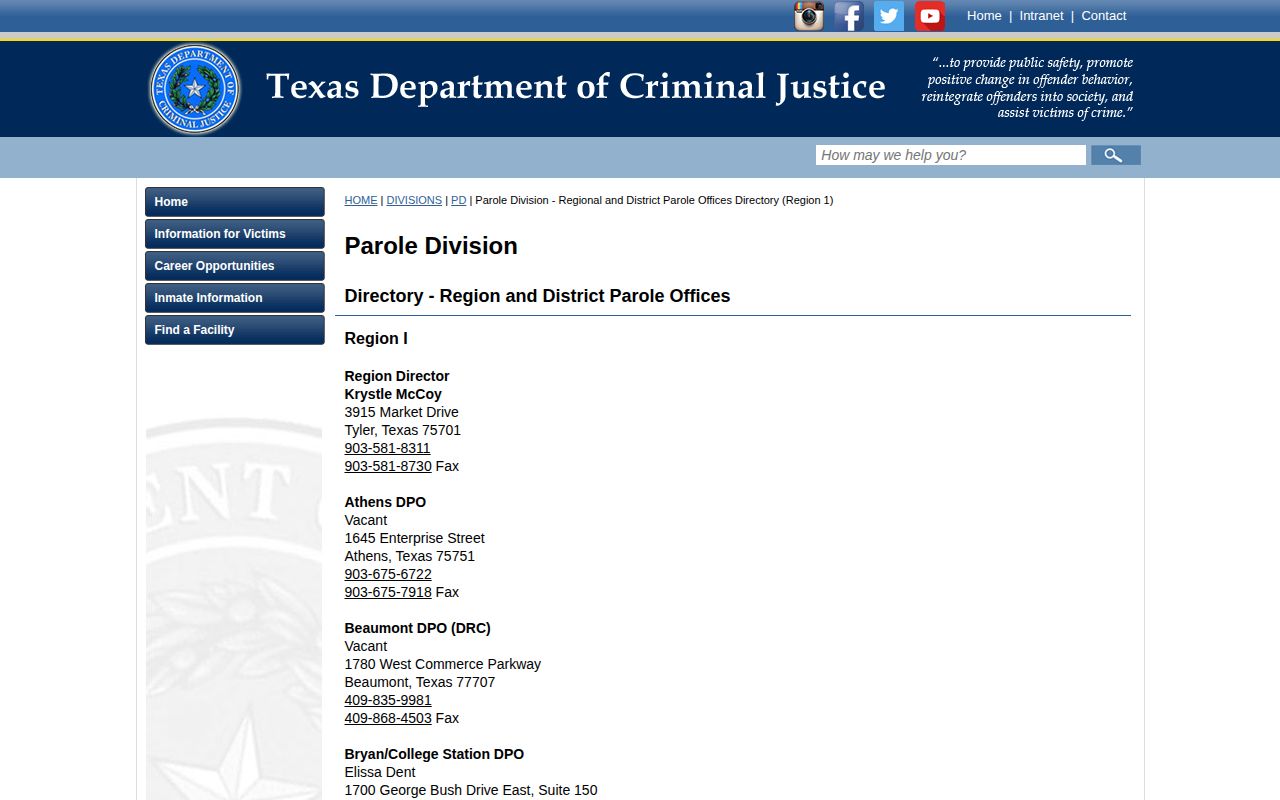
The image helps confirm the correct regional office, but person-level status still requires an authorized official channel.
Titus Release Warrants and Absconders
A release record and warrant clearance are separate findings. TDCJ defines an absconder as a supervised person who stopped reporting and whose whereabouts are unknown. It provides a 24-hour anonymous tip line at 866-680-6667. Yet the public fugitive material is curated, not complete. Full parole-warrant information resides in law-enforcement NCIC and TCIC systems, so the lack of a public result cannot establish that no warrant exists.
The Titus County Sheriff publishes a dedicated address, warrants@co.titus.tx.us, but no public online county warrant list was found. TDCJ’s Warrants Section lists 512-406-5398. Use those contacts to route a lawful status question. Do not treat the jail roster, probation office, or a release notice as warrant clearance.
Titus Supervision Terms Explained
Texas agencies use precise terms. Reading them in the judgment and TDCJ response avoids a false conclusion about whether supervision is active or complete.
- Parole
- Conditional community release from a prison sentence before full discharge.
- Probation
- Court-ordered community supervision administered by the local CSCD.
- Mandatory supervision
- A statutory release form whose eligibility and Board review depend on the offense and governing law.
- Absconder
- A supervised person who stopped reporting and whose location is unknown.
- Detainer
- A request or hold from another authority that may affect release or transfer.
- Discharge
- The official end of a sentence or supervision obligation.
Conditions vary by order and case. A violation allegation can lead to investigation or revocation proceedings, but it is not the same as an ordinary parole review. For an exact end date, obtain the discharge entry or court order rather than estimating from the sentence.
Titus Supervision Records and Discharge
Supervision ends through an official discharge, not merely because no current web result appears. For parole or mandatory supervision, request the public status that TDCJ may release and distinguish it from confidential panel material under Government Code §508.313. Government Code §552.029 keeps specified correctional facts public despite some confidentiality rules, but it does not open an entire parole file. A focused request for actual release date, release manner, public supervision status, and discharge date is more useful than a broad demand.
Probation completion is documented through the sentencing court and local CSCD. Review the judgment, later orders, and docket under the correct court. A person can complete jail custody yet remain on probation, or finish probation long after the booking record has ceased to be current. Conversely, an old probation order may have been discharged. Date every finding and retain the court cause number so that a later order can be matched to the same case.
Texas IVSS and VINELink alerts can give timely notice of a change, but they do not replace discharge proof. For state-prison notifications, TDCJ IVSS offers letter, email, text, combinations, and some phone notices. A custody alert should be checked against the TDCJ or Sheriff record, then against the correct supervision office when the question is whether oversight continues. This chain prevents a custody event from being mistaken for freedom from all legal control.
Titus Parole Review Outcomes
Texas parole outcomes use codes that describe what must happen next. FI-1 and FI-2 are favorable actions with different release processing. Codes such as FI-3R, FI-4R, FI-6R, FI-7R, FI-9R, and FI-18R condition release on a named program or time frame. RMS concerns mandatory supervision. Denial codes include NR, which gives a future review month and year, SA, which calls for service of the balance subject to applicable mandatory supervision, and DMS, which denies mandatory supervision with later review. The Board vote-options page supplies the current definitions.
A favorable code still does not equal physical release. TDCJ may need to complete a program, approve the plan, resolve a detainer, and process the case. New information can also cause a favorable action to be withdrawn. Check the latest Board result, then obtain the actual TDCJ release record. If the result is a denial, use the stated review date rather than assuming a new review will occur on an anniversary of the sentence.
Titus Probation Court Verification
The judgment is the starting record for Titus County probation. It shows that the court ordered community supervision and identifies the cause in which later action will appear. Review later orders for modification, revocation, continuation, or discharge. A jail booking caused by an alleged violation does not itself prove revocation, and release from that booking does not prove that probation ended. The court order resolves the legal status; the CSCD administers the terms.
Use the correct clerk for the case. The Titus County Clerk publishes misdemeanor and Class C appeal coverage, while felony dispositions belong with the District Clerk. Online County Clerk data is described as real time but not official. Preserve the cause number and request a certified or official record when exact supervision status matters. The local CSCD can route an inquiry, but no public statewide probationer name index was established.
Public Record Search
Sponsored Results