
Titus Projected Versus Actual Release
A projected release date is a calculation based on the record as it stands. It can guide planning, but it does not establish that the person left custody. TDCJ labels the field “Projected Release Date” for applicable current prisoners. Its meaning depends on offense date, offense nature, eligibility, and Board action. An actual release record documents the event after it occurs, including the date and manner of departure.
The distinction is sharper at Titus County Jail. A sentenced county prisoner may have a computed sentence end, while a pretrial detainee awaits bond, court action, dismissal, transfer, or another event and therefore has no fixed date. A court setting is not a release date. A transfer is also not a community release. The Titus County released-inmate record path should be used to verify the final outcome.
Find a Titus Projected Date
Begin by locating the authority that computes the date. TDCJ handles a state-prison sentence. The Titus County Sheriff and sentencing court control the source facts for a county-jail term. A federal sentence belongs in the BOP system, not TDCJ. Using the wrong locator may produce no result or an unrelated date.
- Confirm the full name, date of birth, booking number, TDCJ number, and sentencing court when known.
- Determine whether the person is pretrial, serving a Titus County Jail sentence, currently incarcerated by TDCJ, or held by another system.
- For a current state prisoner, search the TDCJ Inmate Search by exact last name and first initial, seven-digit TDCJ number, or State Identification number.
- For a county sentence, obtain the judgment, start date, jail credit, Sheriff computation, conduct-credit record, and any hold information.
- Record the date viewed and source. Recheck near the projected date, then confirm the actual event through the releasing office.
The TDCJ screen demonstrates the current-person fields:
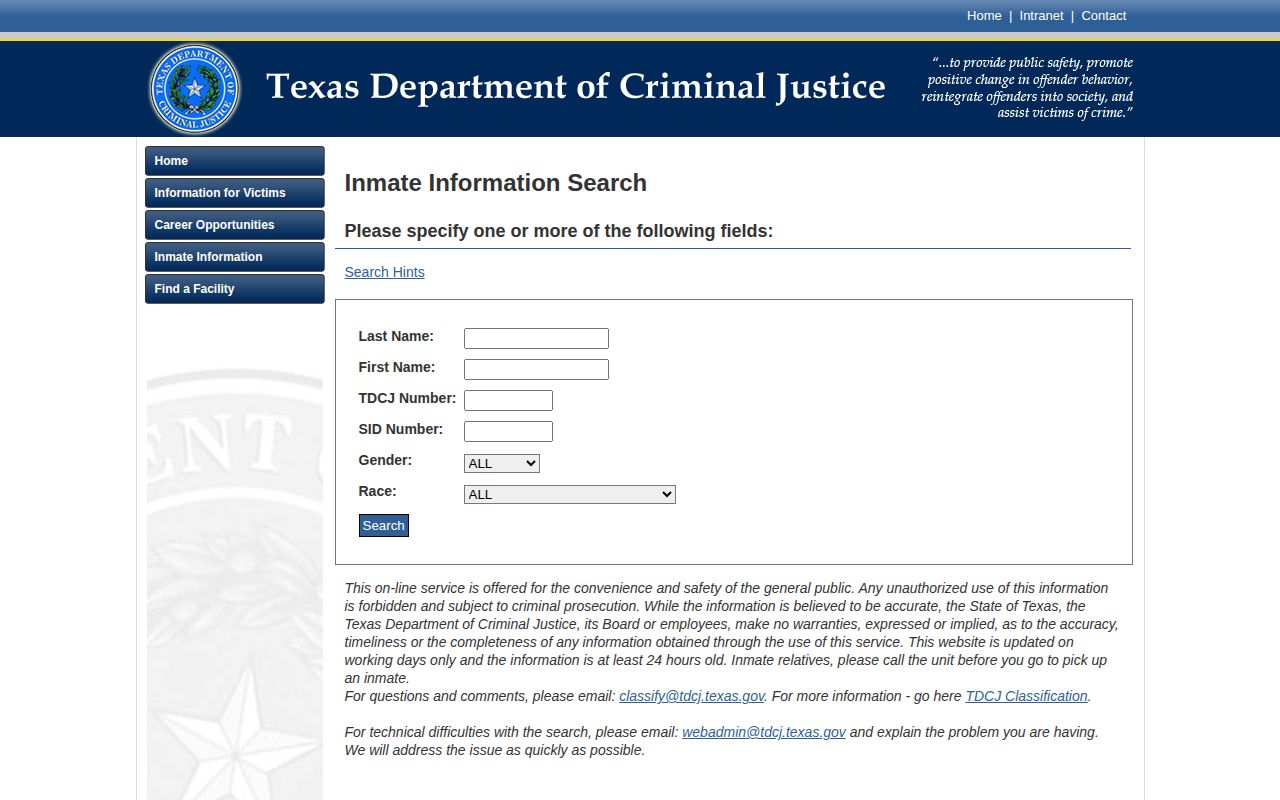
That search includes people currently incarcerated in a TDCJ facility. A missing result does not prove release, and it is not a historical discharged-person archive.
Titus TDCJ Release Date Rules
TDCJ states that its projected date is set by offense date and offense nature. For legally eligible offenses before September 1, 1996, mandatory release occurs on the projected date if parole has not occurred. For eligible offenses on or after that date, mandatory supervision is discretionary with the Board. If the Board denies release or the person is ineligible, TDCJ describes the projection as the discharge date.
Texas has no blanket rule requiring every state prisoner to serve 85 percent. Government Code §508.145 makes parole eligibility turn on the offense, offense date, sentence, and statutory class. Some aggravated cases under Code of Criminal Procedure Article 42A.054 use calendar time without good-conduct time toward a one-half threshold, with statutory limits. That rule is not 85 percent and is not a guaranteed release point.
Government Code Chapter 498 governs TDCJ good-conduct time. Credit is a privilege. It may affect eligibility or a calculation when the governing law permits, but it does not erase part of the court’s sentence or force the Board to approve release. Sections 508.147 and 508.149 govern mandatory supervision and exclusions.
Why Titus Release Dates Change
A projection can move after new facts or official recalculation. Never subtract a fixed percentage from the sentence. The governing offense and sentence record must be read as a whole.
| Factor | Possible effect |
|---|---|
| Corrected judgment or jail credit | Changes the controlling start, credit, or sentence data. |
| Concurrent or consecutive terms | Changes how multiple sentences are combined. |
| Good-time classification | May alter an eligible calculation. |
| Discipline | Can cause forfeiture; authorized restoration can change it again. |
| Parole or mandatory supervision | A Board action may approve, deny, condition, or revisit release. |
| Detainer or warrant | May prevent community release or cause transfer to another authority. |
| Administrative recalculation | Updates the date when source data or legal treatment changes. |
A detainer is a request or hold from another authority. It can mean that departure from one facility leads to another custody system. Confirm both the sending record and the receiving agency before calling the event a release to the community.
Titus County Jail Date Computation
County jail uses different statutes from TDCJ. Under Code of Criminal Procedure Article 42.032, a sheriff may grant a qualifying convicted county prisoner commutation for good conduct, industry, and obedience. The statute allows up to one day deducted for each day actually served when its conditions apply. “May” and “not to exceed” matter. They do not create an automatic Titus County formula, and credit may be forfeited for misconduct.
No written Titus good-time rate, forfeiture policy, or calculator was found. A case-specific computation requires the judgment, custody start, applicable jail credit, Sheriff conduct records, forfeiture, holds, and actual booking-out entry. This county rule does not apply to a pretrial bond release. TDCJ’s projected-date field should not be used for a person serving only a county-jail sentence.
Article 42.035 permits the sheriff to discharge on the preceding business day when a county-jail sentence ends on a weekend or legal holiday, but only if the sheriff determines that early discharge will not endanger public safety. Permission is not a promise. Article 43.13 also contains limited timing and credit provisions with exceptions. It does not establish a routine Titus County release hour.
Confirm Titus Release Date Records
For historical TDCJ information, the official free email route accepts the full name and seven-digit TDCJ number at pia@tdcj.texas.gov. If the number is unknown, supply exact date of birth or approximate age and county of conviction. Ask specifically for public incarceration history, admission date, actual release or discharge date, manner of release, and public supervision status. Formal requests can go through the TDCJ Public Information Act channel.
Pending alerts can supplement that record check. Register through the VINELink Release Check, TDCJ IVSS, or the county-linked portal as appropriate. Alerts may lag and may omit the court reason. Save the notice and note its timestamp, then obtain the Sheriff book-out or TDCJ release record.
The official TDCJ email page shows the projection definition and released-history fallback:
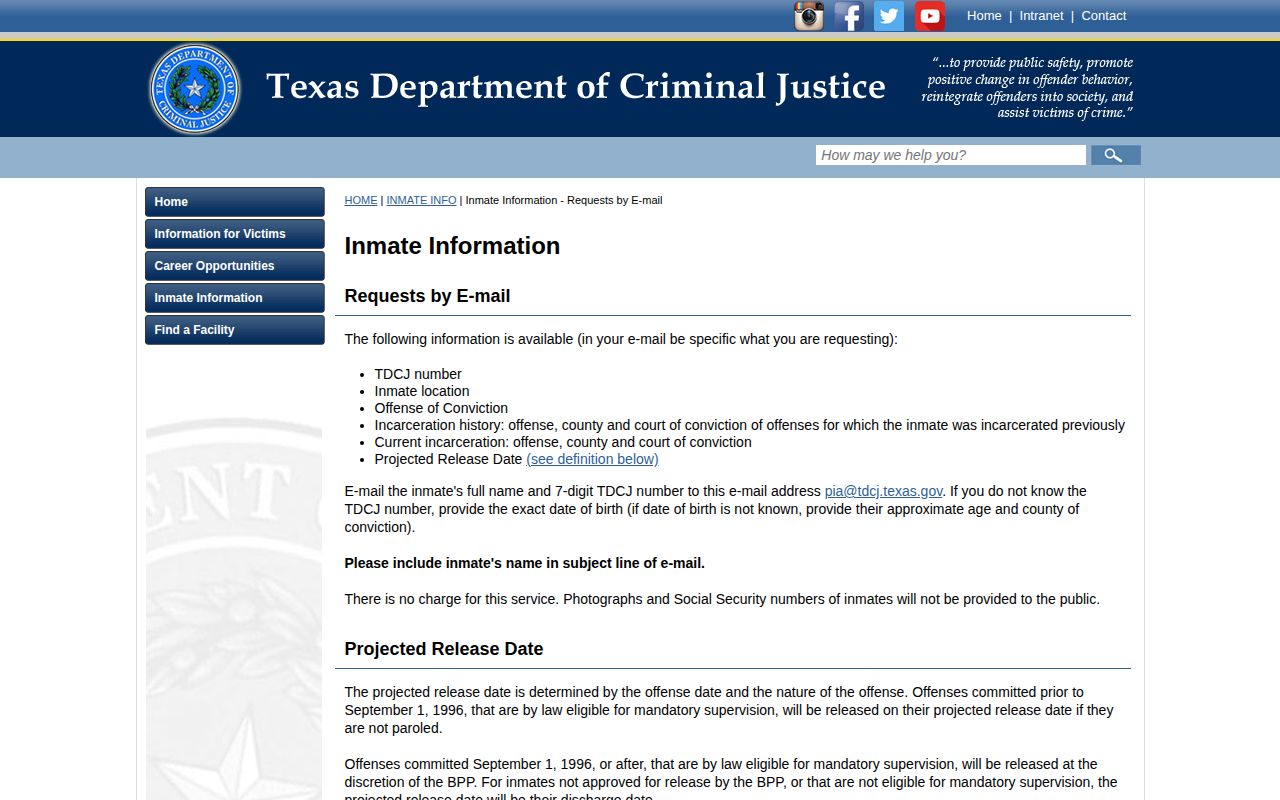
Written confirmation is stronger than a remembered phone statement when the exact date and release type matter.
Titus Eligibility Is Not Release
Eligibility dates, review dates, projected dates, and discharge dates answer different questions. Parole eligibility means the case may be considered under controlling law. The Board reviews and votes the file; it does not promise release on the first eligible day. A favorable code may require a treatment program or other preparation. Release-plan approval, detainers, and administrative work can still stand between the vote and physical departure. The latest official status and actual release entry control.
Mandatory supervision is also not a shortcut to a fixed answer. Government Code §§508.147 through 508.149 govern eligibility and Board review, including listed exclusions and discretionary denial findings. TDCJ may use flat time plus good time in an applicable calculation without guaranteeing that the prisoner leaves on the displayed date. Record the current projection and ask which unresolved decision or hold could change it.
County cases require another distinction. A sentence ending on a weekend or holiday may qualify for preceding-business-day permission under Article 42.035, yet the sheriff must make the public-safety finding. The statute does not create a right to Friday discharge. Ask Titus County Jail for its case-specific computation and any hold, then check the court for a later order. The physical book-out record remains the best proof that the projected event happened.
Titus TDCJ Date Request Details
A former prisoner may not appear in the current TDCJ web search. The free offender-information email route is the first historical fallback. Put the person’s name in the subject and send the full name and seven-digit TDCJ number to pia@tdcj.texas.gov. If that number is unknown, TDCJ asks for the exact date of birth or approximate age and county of conviction. Request the admission date, actual release or discharge date, manner of release, and public supervision or discharge status in clear terms.
TDCJ lists its general inmate-information numbers as 936-295-6371 and 800-535-0283 on weekdays from 8 a.m. to 5 p.m. A phone answer can help route the request, but a written response is easier to preserve. Note the call date, time, office, and exact wording. When the free information route cannot supply the needed historical field, use the formal TDCJ Public Information Act form or PIA@tdcj.texas.gov. Some parole-file material may remain confidential even when basic incarceration and release facts are available.
Titus Sentence Data Checklist
A reliable county-jail calculation starts with source records, not mental arithmetic. Obtain the signed judgment, sentence start, all credit stated by the court, the Sheriff’s custody calendar, any commutation recorded for conduct, and every forfeiture. Check whether multiple terms are concurrent, meaning served together, or consecutive, meaning one follows another. Add later judgments and corrected credit orders before comparing the result with the jail’s computation.
- Judgment date, sentence length, and controlling cause number
- Booking date and court-awarded time credit
- Concurrent or consecutive treatment of other sentences
- Sheriff good-conduct commutation and any forfeiture
- Detainers, warrants, transfers, and later court orders
- Projected date viewed and actual booking-out entry
Article 42.032 permits qualifying credit but does not require Titus County to award the statutory maximum. Article 42.035 permits, but does not compel, an early business-day discharge before a weekend or holiday. Those two discretionary rules make a published generic calculator unsafe for a specific Titus sentence.
Public Record Search
Sponsored Results